Sicily’s loss of political autonomy under Bourbon rule
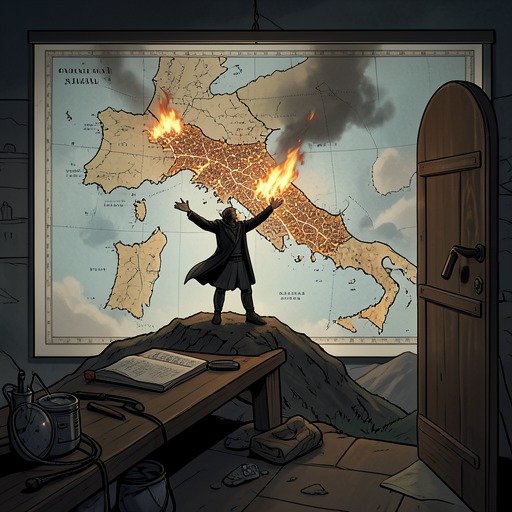
The Florios of SicilySicily’s loss of political autonomy under Bourbon rule is a recurring political condition in the novel, not a single change of government. The Crown’s abolition of the Kingdom of Sicily and revocation of the 1812 constitution place the island under centralized authority; later revolts briefly restore constitutional institutions but fail to secure lasting independence. For the Florios, sovereignty is measured in the practical terms of who controls customs, taxes, ships, credit, and the resources accumulated by Sicilian businesses.
Constitutional Reversal and Centralization
The account links the loss of autonomy to the Bourbon restoration and the reversal of the constitutional settlement. In 1816, the king abolished the Kingdom of Sicily and repealed the 1812 constitution. The island’s grievances remained active: in the novel’s account, people could not forget the insult of losing their kingdom and constitution, and the political change formed part of the background to the later revolt.
The transfer of authority was also administrative. From December 1816, Neapolitans administered state offices and customs and held military commands. Palermo, once a political center, was left without power or independence. Higher taxes, trade restrictions, and new constraints compounded the loss: the economy, already struggling, came to a halt. The novel thus makes centralization legible in both governance and daily economic pressure, rather than treating it as an abstract constitutional dispute.
Division and the Revolts of 1820–1821
The political weakness of the island is associated with divisions among its cities. Palermo, Messina, Trapani, and Catania pursue conflicting interests; even their shared hostility toward rule from beyond the Strait does not produce a durable common political front. The contrast is pointed: Sicily can claim one of the world’s oldest parliaments, yet its cities are unable to act together effectively when the Bourbons return.
In 1820, resistance again brought constitutional government into view. Hatred of Bourbon rule had grown among the aristocracy and through secret societies, and on June 15 a revolt forced Prince Francesco to take refuge in Naples. The Sicilian Parliament was created and the constitution restored. On the mainland, an insurrection led by General Guglielmo Pepe also compelled Ferdinand I to accept a constitution. The parallel movements briefly suggested that political change might reach both sides of the Strait.
The Sicilian revolt, however, had a particular objective: restoring the Kingdom of Sicily and its independence. The Crown exploited discord among Palermo, Messina, and Catania, and the rebellion was suppressed with bloodshed. The monarchy was restored in November, returning Sicily to Neapolitan control. In March 1821, the Holy Alliance powers—Prussia, Russia, and Austria—intervened after Ferdinand I sought their help. Austrian troops entered Naples on March 24 and restored the king to the throne; they remained until 1827. The sequence shows how local divisions and international intervention combined to defeat the island’s constitutional hopes.
Political Ideals and Unequal Stakes
The novel distinguishes the language of popular rights from the interests of the aristocrats who helped set revolt in motion. In a recollection of the 1820 uprising, the abolition of the Sicilian kingdom is described as an affront that the nobility could not forget. Yet the aristocrats’ grievance also concerned the loss of their own power, privileges, and customary offices. They had once protected the Bourbons in 1799, but later resented a Crown that had displaced them and treated Sicily as a possession ruled from elsewhere.
That contradiction complicates the ideal of independence. The aristocracy could mobilize peasants and the poor while seeking to preserve its own command over them; the novel observes that elites could ignite resistance while leaving the vulnerable to bear its costs. Political autonomy therefore appears both as a collective claim against foreign rule and as a contested project shaped by class power within Sicily itself.
Commercial Consequences and the Florios
The loss of self-government is repeatedly experienced through commerce. Spices reach Palermo through long chains of travel, overseas colonies, European ports, and customs systems. The Florios’ warehouse in the Palazzo Steri property lets them hold goods in transit and pay import tariffs only when the goods enter Palermo. Such arrangements make customs administration an immediate business concern: a change in who governs the island can alter the conditions under which goods are stored, taxed, and sold.
The political crisis of 1848 makes that connection explicit. When customs officials halt outgoing ships amid the formation of a provisional government, a Florio shipment is caught in the stoppage. Later, Vincenzo tells Giulia that he has bought rifles in England for the revolutionary committee and that the Sicilian Steamship Company’s vessel Palermo has been taken by the revolutionary government to transport troops. Trade has fallen by half since the revolt began. The episode places the family’s ships and capital inside the struggle over sovereignty: they are useful to the new government, but the demands of the revolution endanger the commercial world Vincenzo has built.
From Bourbon Rule to Unification
The novel does not present the end of Bourbon authority as an uncomplicated recovery of Sicilian control. During the events surrounding Garibaldi’s arrival, Vincenzo, acting as a trade governor, orders the cash and bank drafts transferred to a safe while anticipating that Garibaldi’s men will requisition the substantial gold reserves. His response registers the continuing vulnerability of institutions and wealth when political authority changes hands.
After unification, Vincenzo argues that the Piedmontese are turning Sicily into a colony and condemns the transfer of the Bourbon Crown treasury to Piedmont to pay the costs of annexation. Giulia counters with the ideal of a united nation and the sacrifices made for it; Vincenzo’s objection is that Sicily’s political subordination has not necessarily ended with the Bourbons. The conflict extends the subject beyond the restoration and revolts: the novel asks whether a change of rulers has delivered self-government, or merely moved the center of control elsewhere. Across the Florios’ commercial fortunes, autonomy remains inseparable from who can command the island’s institutions and claim its resources.